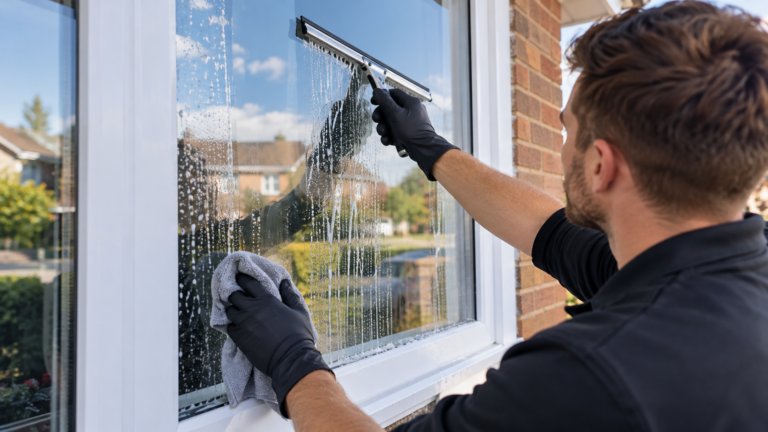
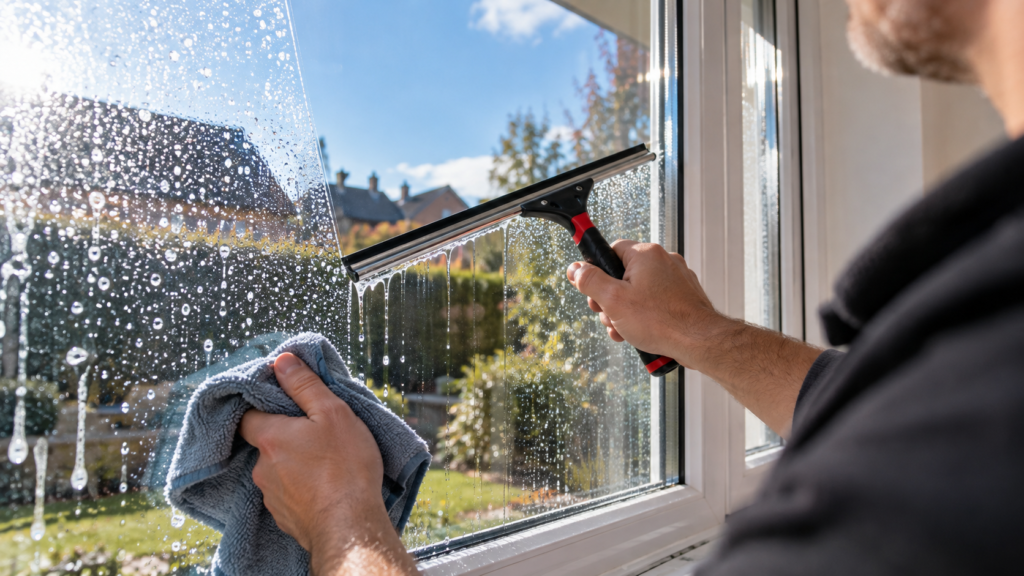
Streaks are rarely a sign that you did not clean hard enough. They are something left behind on the glass: soap, minerals from the water or dirt from a cloth that has dried in lines. Get rid of what causes them and the streaks go too.
This guide explains why windows streak after cleaning, the method that avoids it, the cloths that help and how to fix streaks you have already left. If you want the full routine from frames to sills, start with our guide on how to clean windows.
Why Windows Streak After Cleaning
Almost every streak comes back to one of four causes. Knowing which one you are dealing with makes the fix obvious.
Too Much Detergent
Washing-up liquid lifts grease, but anything that is not rinsed or wiped off stays on the glass as a thin film. That film dries in the pattern of your last wipe. A few drops in a bucket of warm water is enough, and more soap only makes the glass harder to clear.
Dirty Water and Dirty Cloths
Once the water in your bucket turns cloudy, you are putting dirt back on the glass. The same goes for a cloth that has already picked up grime from the frames. Cloths washed with fabric conditioner are another common cause, because the conditioner coats the fibres and leaves a greasy smear.
Cleaning in Direct Sun
Sun on the glass dries the water before you can remove it. Whatever was in that water, soap or dirt or minerals, is left behind as a mark. This is why a window cleaned at midday in summer often looks worse than one cleaned on a grey morning.
Hard Water and Mineral Marks
Tap water carries dissolved minerals, and when it dries on the glass those minerals stay behind as spots and a dull haze. Thames Water says most of the water in the South-East of England is hard, so homes across London and Kent are more likely to see these marks. Hard water can also leave the chalky residue known as limescale.
How to Clean Windows Without Streaks
The method below keeps every one of those causes off the glass. Work on one window at a time so nothing dries before you reach it.
- Pick a cool, dull moment: clean on an overcast day, or start with the windows that are in shade.
- Clean the frames first: wipe the frames and sills so dirt does not run onto clean glass later.
- Use fresh, lightly soapy water: a few drops of washing-up liquid in warm water, changed as soon as it looks cloudy.
- Wet the glass, do not flood it: wring out the sponge or applicator so it does not drip.
- Remove the water in straight strokes: pull a squeegee from the top down, wiping the blade after every stroke. With a cloth, wipe in one direction rather than in circles.
- Buff with a dry cloth: finish with a clean, dry microfibre cloth, paying attention to the edges and corners.
Speed matters as much as technique. The longer the water sits on the glass, the more chance it has to dry in the wrong place.
The Best Cloths and Tools for Streak Free Windows
Your tools decide most of the result, and the right ones cost very little. These are the ones that make the difference:
- Microfibre cloths: they hold water, lift grease and do not shed fluff. Keep one for washing and one for drying.
- A squeegee with a sharp blade: a nicked or hardened rubber blade leaves lines, so replace it when it stops gliding cleanly.
- A bucket you rinse out: start each session with a clean bucket, not one with last month's grime in the bottom.
- Clean, conditioner-free cloths: wash them on their own, without fabric conditioner, and let them dry fully.
Skip kitchen roll and old cotton tea towels. Both leave fibres on the glass that show up as soon as the light hits it.
Streaks on the Inside vs the Outside
The two sides of the same pane streak for different reasons. Knowing what you are cleaning off tells you how to clean it.
Inside the House
Indoor glass collects fingerprints, cooking grease in and near the kitchen, overspray from polish and air freshener, and marks left where condensation has run down and dried. These are oily films rather than loose dirt, so a dry wipe only spreads them around. Wash them off with lightly soapy water first, then buff dry.
Outside the House
Outside, the glass picks up traffic film, pollen, dust and bird mess. Rain does not wash it clean: as raindrops dry they leave the dirt they carried behind as spots. Outdoor glass needs more water and a proper rinse, and it is where hard water marks show up most.
How to Get Rid of Streaks You Have Already Left
If the glass is already streaky, adding more cleaner usually makes it worse. Rinse first with clean water to lift the film, then dry the glass with a fresh microfibre cloth, working from the top down.
To find out which side of the glass a streak is on, wipe the outside with vertical strokes and the inside with horizontal ones. The direction of the streak tells you where to go back to. Check the glass from an angle and in daylight, as that is when any film left behind shows up.
Keeping Windows Streak Free for Longer
Clean glass stays clear longer when the dirt around it is under control. Wipe the frames and sills between cleans, since that is where the dirt that runs onto the glass comes from.
Inside, open a window or use an extractor fan when cooking and drying clothes, so less condensation forms on the glass. Wipe any condensation away with a dry cloth in the morning rather than letting it dry in streaks. Outside, regular cleaning matters more than a single deep clean, because a light layer of dirt comes off far more easily than a thick one.
Why Purified Water Dries Without Streaks
Every cause of streaks above has one thing in common: something is left on the glass when the water dries. Take everything out of the water, and there is nothing left to mark the glass. That is the idea behind pure water window cleaning.
Our vehicle-mounted Reach & Wash system purifies tap water and carries it in large tanks in our vans. We pump it up telescopic poles with brush heads at the end, scrub the frames, glass and sills, then rinse the window and leave it to dry naturally. There is no detergent to leave a film, no cloth to smear the glass, and because the water is so pure, it dries without leaving marks.
No dirty water or cloths used on other houses ever touch your windows, and everything is done from the safety of the ground, upstairs windows included. It is the method we use on every residential window clean, with frames, sills and door panels always included.
Red Point Cleaning Service is a family-run, fully insured business that has cleaned windows across South East London for 15 years, including window cleaning in Bromley and Orpington. All our work is guaranteed: if you are not happy, we re-clean the same or the following day free of charge.